Showing posts with label Thailand. Show all posts

Thursday, October 2, 2014

Participants of SATNET interregional visit take part in Workshop on Good Practices in Trade Facilitation

On day 4 (26 September 2014) of the Interregional Visit for Smallholder Value Chain Actors on Agricultural Trade Facilitation and Market Linkages in Thailand, the participants took part in the ‘SATNET Asia Workshop on Good Practices in Agricultural Trade Facilitation in South and Southeast Asia’ organized by the Trade and Investment Division of the United Nations Economic and Social Commission for Asia and the Pacific (ESCAP) in collaboration with multiple partners, in Bangkok. The objective of the workshop was to enable inter- and intra-regional learning among participating countries on policies, measures, initiatives, projects or cases that facilitate trade of agriculture or food products.

Close to 40 delegates from Bangladesh, Bhutan, Cambodia, India, Lao PDR, Myanmar and Nepal representing government, private sector and civil society stakeholders participated in the workshop. The various sessions focussed on cases and processes relating to agricultural trade facilitation, good practices in logistics and trade facilitation, and the emergence of standards and traceability. A number of senior policymakers and experts served as resource persons and shared their knowledge and experience with the participants. 


During the wrap up session of the workshop, participants provided their feedback on both the Interregional Visit and the Workshop. They conveyed that the site visits to Kasetsart University, Thayang farmers cooperative, Talaad Thai wholesale market, and Sampran Riverside resort had enhanced their capacities and provided them useful knowledge and practical insights which they will implement and disseminate in their home countries. The need for continuing a network like SATNET beyond the immediate duration of the project was also expressed. In the workshop, the sharing of cases from various countries and the discussion on Traceability were found to be particularly relevant. 
Participants of SATNET interregional visit learn about wholesale market operations and organic farming

Talaad Thai wholesale market
On day 3 (25 September 2014) of the Interregional Visit for Smallholder Value Chain Actors on Agricultural Trade Facilitation and Market Linkages in Thailand, the participants visited the Talaad Thai Fruit and Vegetable Wholesale Market in Pathumthani province near Bangkok - one of the largest fruit and vegetable wholesale markets in Thailand. They were welcomed by the senior management of the company who presented an overview of the operations of the market. Talaad Thai is spread over an area of 200 acres, with a capacity of handling 15,000 tons of produce a day and having a daily cash flow of 400 – 500 million Thai Baht (USD 12 – 15 million). It is divided into various zones, each dedicated to trading of a particular product or product category. The revenue of the company comes from commissions paid by permanent traders (who are allotted a permanent trading space in the market), entrance fee from non-permanent traders, and rentals for office space.

The participants visited the vegetable, seafood and fish, fruits, and flower trading zones to get a first-hand feel of how the market operates. They also visited the waste recycling facility, and the contamination testing laboratory which tests 150 random samples every day to ensure the quality of the produce marketed at Talaad Thai. The participants keenly observed various aspects of the market and sought additional information from the staff for a better understanding of the market. Participants from Bangladesh conveyed the visit was very useful for their plans to set up a local wholesale market in their home country.

Visit to farmers resource centre at Sampran riverside 
In the afternoon, the participants visited the Sampran Riverside resort in Sampran district which is implementing an innovative social enterprise to develop a value chain of organic producers. The ‘Sampran Model’ project has been promoting organic practices in the local farming community to break the vicious cycle of chemical inputs – land degradation – pest resurgence - more chemical inputs – increase in debt and health problems. In addition to advocating the benefits of organic farming and providing training to farmers, the project helps in marketing of the produce through the ‘TalatSookjai’ weekend market and sourcing for the resort’s own needs. It is also enabling market linkages for farmers with five-star hotels and offices in Bangkok. The project represents a partnership between the local community, private sector (for financial support), local government agencies and universities (for knowledge and training). Two hundred and twenty five local farmers have enlisted their interest in taking up organic farming and some of them have already attained organic certification from the International Federation of Organic Agriculture Movements (IFOAM). The participants saw a presentation on the project, and expressed strong interest in the outcomes and new perspectives emerging from the project. They also visited the resource centre run by the resort for farmers and learnt about various tools and products such as soil analysis kit, organic plant growth promoters, botanical insecticides, trichoderma (a beneficial fungi), and vermicompost.  
Group photo


Thursday, September 25, 2014

SATNET interregional visit participants visit organic banana producer group

Presentation on Thayang Agriculture Cooperative
On day 2 (24 September 2014) of the ongoing Interregional Visit for Smallholder Value Chain Actors on Agricultural Trade Facilitation and Market Linkages in Thailand, the participants visited the Thayang Agriculture Cooperative, a farmers cooperative and producer group in Phetchaburi province that has been producing and exporting organic banana to Japan since 1992. 

Air-drying of banana
The participants were welcomed by the cooperative staff who presented an overview of the work of the cooperative. Established in 1966, the cooperative currently has 2,100 members and provides saving, financing, product collection, and marketing services to the members. It offers technical support through extenionists for organic cultivation practices, loans for investing in agricultural inputs, and assistance with marketing for banana as well as other fruits and vegetables produced by the members, thus eliminating the role of middlemen and enabling realization of higher prices by the members. Export of bananas to Japan takes place under a business agreement and annual contract. The production takes place as per Good Agricultural Practices (GAP) standards, and is closely monitored through maintenance of records and orchard visits by staff in order to ensure quality. Apart from the export market in Japan, the bananas are also supplied to leading hotel and supermarket chains in Thailand. 

Bar-coding
The participants visited the processing facility of the cooperative wherein they were able to see operations like delivery of bananas from the producers, washing and cleaning, air drying, packaging, and bar coding. A paper-based traceability system is in place for recording information on the banana production.   

  
Participants at Thayang Agriculture Cooperative
Fifth SATNET interregional visit begins in Thailand with focus on agricultural trade facilitation and market linkages

The fifth and final SATNET Interregional Visit for Smallholder Value Chain Actors on Agricultural Trade Facilitation and Market Linkages (23-26 September 2014) has commenced in Thailand. The event provides practical exposure to key stakeholders in South and Southeast Asia to good practices and technologies in agricultural trade facilitation and the development of market linkages as a means to address food security and poverty reduction, and involves site visits in Bangkok and neighbouring districts. Close to forty participants from Bangladesh, Bhutan, Cambodia, India, Lao PDR, Myanmar and Nepal including representatives of the Ministries of Commerce and Agriculture, small-scale agri-business operators, industry associations concerned with agricultural trade and marketing, farmer associations and smallholder cooperatives engaged in exports are taking part.

The visit has been organized by the Centre for Alleviation of Poverty through Sustainable Agriculture (CAPSA) and the Trade and Investment Division (TID) of the Economic and Social Commission for Asia and the Pacific (UNESCAP), in partnership with Kasetsart University, Thailand.

Presentation on postharvest for horticulture
On day 1 (23 September), the participants visited the Kamphaeng Saen campus of Kasetsart University (KU) in Nakon Pathom province. Dr. Panatda Kasikitwiwat from the Center of Excellence in Logistics at KU made a presentation on logistics and supply chain for agriculture to provide an overview on the main theme of the visit. Concepts on logistics and supply chain as well as innovations in agro-logistics were discussed. This was followed by a presentation from Dr. Apita Bunsiri of KU’s Postharvest Technology Center on postharvest for horticulture and postharvest technology alternatives for fruits and vegetables. During the session, the physiology of fruits and vegetables as well as various technologies and practices for reducing postharvest losses and increasing the shelf life of the produce in the preharvest, handling, packaging, storage and transportation stages were covered in depth. Dr. Bunsiri shared a number of practical tips from her own experience in working with farmers and transferring good practices to them – both in Thailand and other countries like Nepal and Cambodia - and provided useful suggestions for exporting produce to key markets in Asia, Europe and North America. The session emphasised low-cost methods that utilize materials available locally with the farmers (eg. ways to prevent bruising of the fruits, hot water treatment, use of edible-grade wax, and Zero Energy Cooling Chamber). 


Laboratory sessions
The presentations were complemented by a session in the lab where some of the techniques for packaging and preservation of products like mango, chilli, lemon and pomelo to extend their shelf lives were demonstrated (eg. use of bio-plastic). The participants were able to compare the results of the technologies vis-a-vis control (untreated) samples. 

Overall, the sessions were marked with active discussions and enthusiastic interaction between the participants and the experts, and the participants were also able to share their own knowledge and ideas. 

Friday, July 25, 2014

The final day of SATNET field visits focuses on markets and farmer field schools

The final day of SATNET intraregional visit for smallholder value chain actors in Thailand was devoted to visiting the Si-Moom-Muang fruit and vegetable wholesale market in Bangkok. This market has been in operation for 30 years and is currently among the largest wholesale markets in Thailand, handling about 20,000 buyers/sellers and 4 million tons of produce every day. The market is run by a private company whose senior management welcomed SATNET participants and explained about the functioning of the market in detail. An interactive session that followed enabled the participants to obtain more information about various aspects of marketing of agricultural produce.

Subsequently, the participants visited the market’s pesticide residue testing laboratory, which is important for ensuring quality control over the produce sold in the market, as well as the selling area spread over a vast space, and the waste recycle facility. They were able to see how various units are integrated with each other, and how coordination of the activities allows for smooth transaction of daily market business.

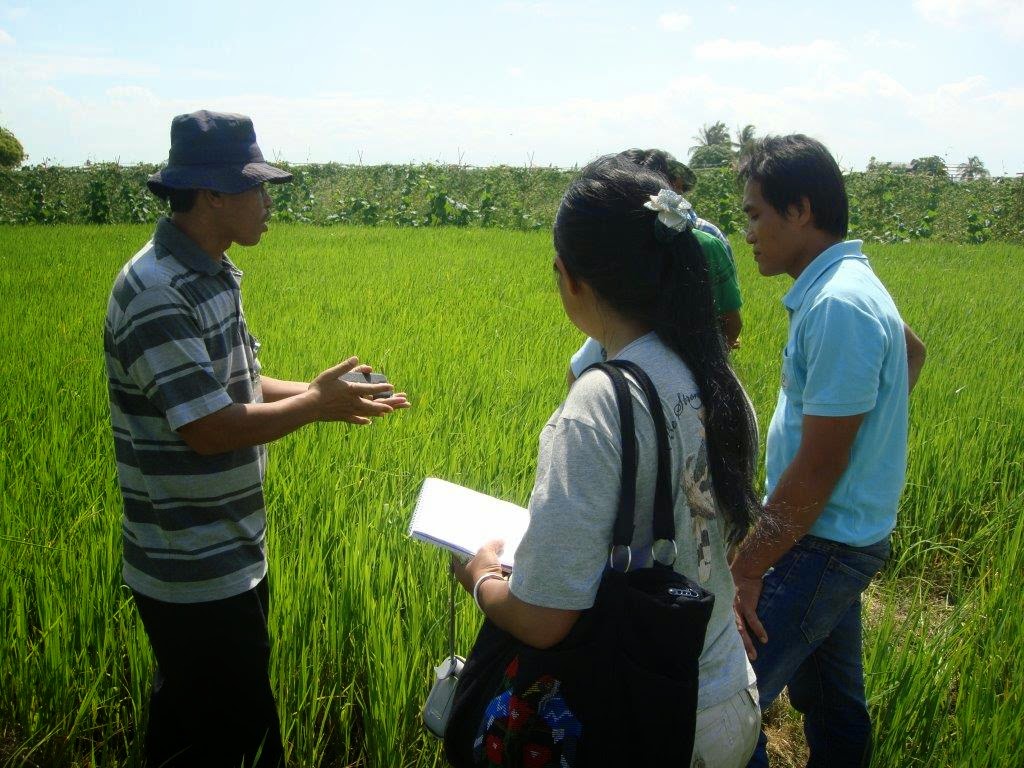
In the afternoon, the participants attended a practical Farmer Field School session for rice conducted with the assistance of the Department of Agricultural Extension in Ayuddhaya province. During the session, it was explained that a participatory approach is adopted to prioritize the problems faced by local farmers, identify their causes, plan field experiments to test potential solutions, and finally arrive at the actions to implement to solve the problems. 

As part of the session, participating lead farmers presented the results of ongoing field trials hosted by them for testing various varieties of rice, embodying the ‘farmers as researchers’ concept. The participants also visited the site of the trials and got a valuable opportunity to interact with the local farmers to understand their approach.  

A wrap up meeting was held in the evening to obtain feedback and suggestions from participants of the visit. 

Thursday, July 24, 2014

Visiting progressive farmers and children’s learning centre on sustainable agriculture in Thailand

The third day of SATNET intraregional visit for smallholder value chain actors in Thailand included visits to farms of two progressive farmers in Nakhonpathom province. The first farmer is cultivating vegetables using sustainable practices and aims to achieve organic certification soon. The participants learned about vegetable cultivation, production of liquid bio-fertilizer, vermicomposting, preparation and application of Bacillus Thuringiensis (Bt) and Neem-based products as biopesticides, as well as innovative irrigation methods. The visitors benefited from detailed explanation specific to various processes. They also visited a local farmer community learning centre, which is actively promoting sustainable agriculture.

The second visiting site – Sufficiency Economy for Life School – is a learning centre for children from underprivileged background and the neighbouring farming community to become more aware about sustainable agriculture. The centre is developing and disseminating innovative practices that are simple and low cost, while at the same time sustainability- and productivity-enhancing. Examples include vegetable production and sprouting, grafting, insect traps, zero energy cold storage, vermicomposting, frog rearing, and liquid bio-fertilizer production. The site is also generating biogas and half of its electricity requirements are met through solar power. The participants observed the techniques and practices with enthusiasm and learned about how they are packaged to better appeal to students and youth. 

Wednesday, July 23, 2014

Participants in SATNET’s field visits in Thailand learn about vegetables, bio-control of pests and post-harvest techniques

On the morning of the second day of SATNET intraregional visit for smallholder value chain actors in Thailand, participants visited the demonstration plots of AVRDC – The World Vegetable Center at the Kamphaeng Saen Campus of Kasetsart University.  They were welcomed by the Acting Regional Director and had an opportunity to learn about various varieties of vegetables as well as their production techniques.

They also visited the Postharvest Technology Centre at the same campus. Research staff explained about the Centre’s work and its research services. An in-depth practical session on assessing the shelf life of fruits and vegetables followed this introduction. Participants conducted simple experiments to determine the respiration rate of these products. A visit to various labs and research facilities of the Centre was also conducted to demonstrate preservation techniques for produce such as chilli, coconut, pomello, guava and flowers (e.g. lotus). The Centre’s staff shared numerous tips and suggestions for the benefit of the participants.

In the afternoon, the participants visited the Pest Management Centre in Suphanburi province. The Centre is working to promote biological control of pests as an alternative to using toxic chemical pesticides in the Western region of Thailand. The staff of the centre gave a comprehensive and step-by-step demonstration of processes for production of Trichogramma, rearing of farmer-friendly insects (parasitoids) such as Earwig and Green Lacewing, and multiplication of Trichoderma (a beneficial fungi). These sessions were highly interactive and interesting for participants, some of whom also began to explore plans to implement these techniques in their home countries.  


Tuesday, July 22, 2014

Breaking language and cultural barriers on the first day of SATNET’s field visit in Thailand

The first SATNET intraregional visit for smallholder value chain actors commenced in Thailand on Monday, 21 July 2014. Over the next four days, 20 participants from Cambodia, Lao People’s Democratic Republic (PDR), Indonesia and Myanmar comprising of lead farmers, grassroots civil society representatives, and government officials – many of whom are travelling outside their home countries for the first time – will get an opportunity to visit research centres and farmers' fields to observe best practices in crop production technologies, integrated pest management (IPM) and post-harvest and marketing. The objective is to enable them to support the dissemination and adoption of these practices in their own communities.

The first activity on the opening day was a visit to the Department of Agricultural Extension of Thailand’s Head Office in Bangkok, where the Director of the Biological Control Promotion Group welcomed the visitors, and presented the work of the Department. The most interesting part was the sharing of valuable knowledge and practical experience from Thailand in relation to good practices such as farmer field schools, lessons learned, and success factors in working with farmers. The participants asked lots of questions about specific pests and technologies to control them.

In the afternoon, the group visited the farm of Mr. Krow, a progressive farmer growing vegetables and lemons as per Good Agricultural Practices (GAP) standards in Sai-noi district of Nonthaburi province. His farming activities are well integrated with waste management – waste from one process serving as input into another. The products are of high quality and sold to chains such as Seven Eleven as well as exported to Singapore. The visitors got a hands-on opportunity to see innovative practices in organic vegetable production, lemon cultivation, vermicomposting and production of liquid bio-fertilizer. There was an air of excitement as participants saw new techniques and had in-depth discussions to compare them with what they do back home.

Although the participants came from diverse communities and contexts, it was heartening to see barriers of language and cultures crashing down with all of them interacting in an atmosphere of friendship and shared learning.  An enriching day for everyone!