Wednesday, August 6, 2014

Successful kick-off to SATNET field visit in Cambodia

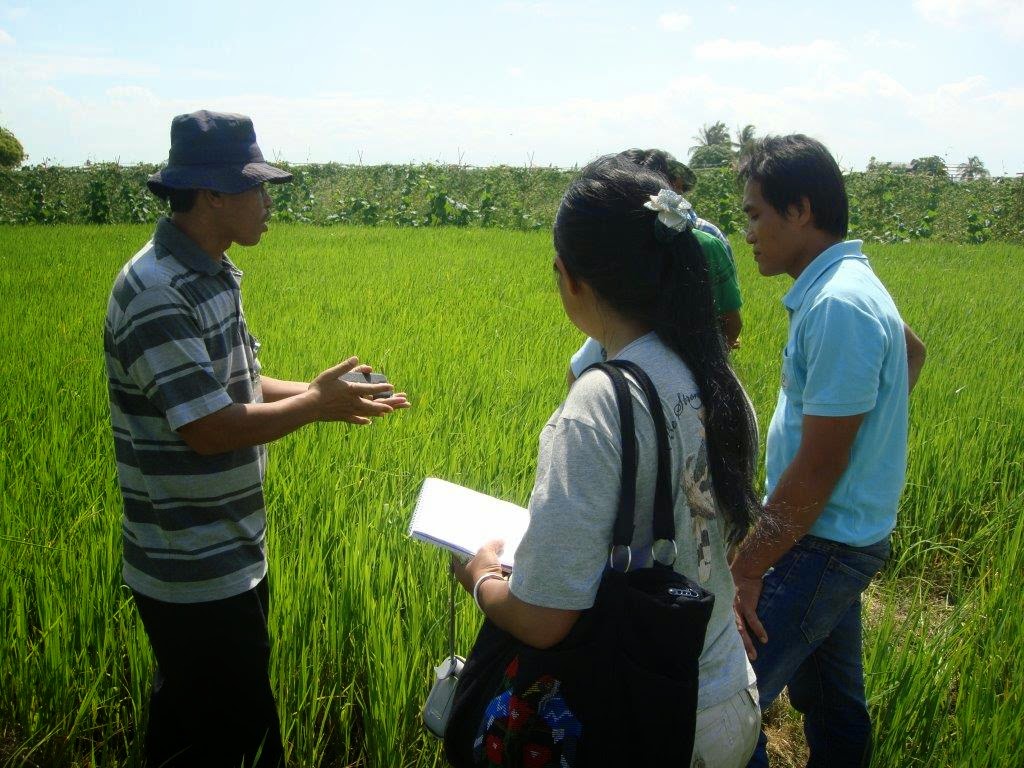
The second SATNET Intraregional Visit for Smallholder Value Chain Actors got underway in Cambodia on Tuesday, 5th August 2014 in collaboration with the Cambodian Center for Study and Development in Agriculture (CEDAC). There are 19 participants representing farmer organizations, extension workers, grassroots NGOs and government departments from Cambodia, Lao PDR, Indonesia and Myanmar taking part in the visit which focuses on crop production technologies, Integrated Pest Management (IPM) and post-harvest and marketing. 
   
CEDAC President sharing learnings
from Centre's work
The first day was devoted to a meeting in which the participants were welcomed by the President of CEDAC and provided an overview of the SATNET project as well as the objectives of the visit in the morning session. Subsequently, they took turns to brief each other about the work they do in their own countries to promote sustainable agricultural practices, their priorities and constraints, and expectations from this visit.

Opening day of the Cambodia visit
In the afternoon, CEDAC staff presented about some of the key programmes of the Center. Among the leading NGOs in Cambodia, CEDAC has supported 160,000 families (8% of total farm households in the country) from over 72,000 villages. The participants learnt about the Centre’s initiatives in the areas of System of Rice Intensification (SRI), organization of organic rice and vegetable producers, establishment of self-reliant saving groups, and linking of farmers to markets which have given them greater ownership and control over the entire value chain. This discussion was very interactive with the participants asking for more information and sharing their own perspectives. Over the next couple of days, the participants will also see many of these programmes in action in farmer fields as part of the site visits.

The day ended with all participants joining for a pleasant river boat ride and city tour in Phnom Penh! 

Friday, July 25, 2014

The final day of SATNET field visits focuses on markets and farmer field schools

The final day of SATNET intraregional visit for smallholder value chain actors in Thailand was devoted to visiting the Si-Moom-Muang fruit and vegetable wholesale market in Bangkok. This market has been in operation for 30 years and is currently among the largest wholesale markets in Thailand, handling about 20,000 buyers/sellers and 4 million tons of produce every day. The market is run by a private company whose senior management welcomed SATNET participants and explained about the functioning of the market in detail. An interactive session that followed enabled the participants to obtain more information about various aspects of marketing of agricultural produce.

Subsequently, the participants visited the market’s pesticide residue testing laboratory, which is important for ensuring quality control over the produce sold in the market, as well as the selling area spread over a vast space, and the waste recycle facility. They were able to see how various units are integrated with each other, and how coordination of the activities allows for smooth transaction of daily market business.

In the afternoon, the participants attended a practical Farmer Field School session for rice conducted with the assistance of the Department of Agricultural Extension in Ayuddhaya province. During the session, it was explained that a participatory approach is adopted to prioritize the problems faced by local farmers, identify their causes, plan field experiments to test potential solutions, and finally arrive at the actions to implement to solve the problems. 

As part of the session, participating lead farmers presented the results of ongoing field trials hosted by them for testing various varieties of rice, embodying the ‘farmers as researchers’ concept. The participants also visited the site of the trials and got a valuable opportunity to interact with the local farmers to understand their approach.  

A wrap up meeting was held in the evening to obtain feedback and suggestions from participants of the visit. 

Thursday, July 24, 2014

Visiting progressive farmers and children’s learning centre on sustainable agriculture in Thailand

The third day of SATNET intraregional visit for smallholder value chain actors in Thailand included visits to farms of two progressive farmers in Nakhonpathom province. The first farmer is cultivating vegetables using sustainable practices and aims to achieve organic certification soon. The participants learned about vegetable cultivation, production of liquid bio-fertilizer, vermicomposting, preparation and application of Bacillus Thuringiensis (Bt) and Neem-based products as biopesticides, as well as innovative irrigation methods. The visitors benefited from detailed explanation specific to various processes. They also visited a local farmer community learning centre, which is actively promoting sustainable agriculture.

The second visiting site – Sufficiency Economy for Life School – is a learning centre for children from underprivileged background and the neighbouring farming community to become more aware about sustainable agriculture. The centre is developing and disseminating innovative practices that are simple and low cost, while at the same time sustainability- and productivity-enhancing. Examples include vegetable production and sprouting, grafting, insect traps, zero energy cold storage, vermicomposting, frog rearing, and liquid bio-fertilizer production. The site is also generating biogas and half of its electricity requirements are met through solar power. The participants observed the techniques and practices with enthusiasm and learned about how they are packaged to better appeal to students and youth. 

Wednesday, July 23, 2014

Participants in SATNET’s field visits in Thailand learn about vegetables, bio-control of pests and post-harvest techniques

On the morning of the second day of SATNET intraregional visit for smallholder value chain actors in Thailand, participants visited the demonstration plots of AVRDC – The World Vegetable Center at the Kamphaeng Saen Campus of Kasetsart University.  They were welcomed by the Acting Regional Director and had an opportunity to learn about various varieties of vegetables as well as their production techniques.

They also visited the Postharvest Technology Centre at the same campus. Research staff explained about the Centre’s work and its research services. An in-depth practical session on assessing the shelf life of fruits and vegetables followed this introduction. Participants conducted simple experiments to determine the respiration rate of these products. A visit to various labs and research facilities of the Centre was also conducted to demonstrate preservation techniques for produce such as chilli, coconut, pomello, guava and flowers (e.g. lotus). The Centre’s staff shared numerous tips and suggestions for the benefit of the participants.

In the afternoon, the participants visited the Pest Management Centre in Suphanburi province. The Centre is working to promote biological control of pests as an alternative to using toxic chemical pesticides in the Western region of Thailand. The staff of the centre gave a comprehensive and step-by-step demonstration of processes for production of Trichogramma, rearing of farmer-friendly insects (parasitoids) such as Earwig and Green Lacewing, and multiplication of Trichoderma (a beneficial fungi). These sessions were highly interactive and interesting for participants, some of whom also began to explore plans to implement these techniques in their home countries.